By Tom
St. Louis closer Ryan Helsley lost his salary arbitration a week and a half ago. Cardinals ownership, perhaps pressed financially after news broke that the RSN they have a 30% stake in would be part of a larger conglomerate filing for bankruptcy, couldn’t be bothered to pay their hard-throwing reliever an extra $850,000.
Helsley wasn’t the only player to lose their case. 19 players went to arbitration hearings in February with only 6 winning their cases before an impartial counsel. Helsley provided back-end stability for a bullpen that ranked 19th in the Majors last season; his performance was so exemplary he tallied the 6th highest fWAR among all relief pitchers. Helsley was a top 10 pitcher in K% (3rd), WHIP (2nd), and SIERA (6th). He ranked as the best reliever in leaving runners stranded (93.4%) as well as opponent batting average (.128). He threw the fastest pitch in MLB last season at a 104.2 mph–his average heater velocity sitting at an astounding 99.7 mph, which, funnily enough, was 3rd in the league among qualified relievers.
Don’t tell the St. Louis Cardinals and their MLB representation though. Arbitration hearings have a history of being venomous and personal. Some players are able to treat the hearings as part of the business, a rite of passage to playing major league baseball. Take Jerry Blevins who took the Washington Nationals to arbitration over $200,000 in 2015; Blevins did so out of principle and a sense of solidarity for the next guy like him looking for a pay raise; he was traded in-division to the rival Mets at the end of March that year.
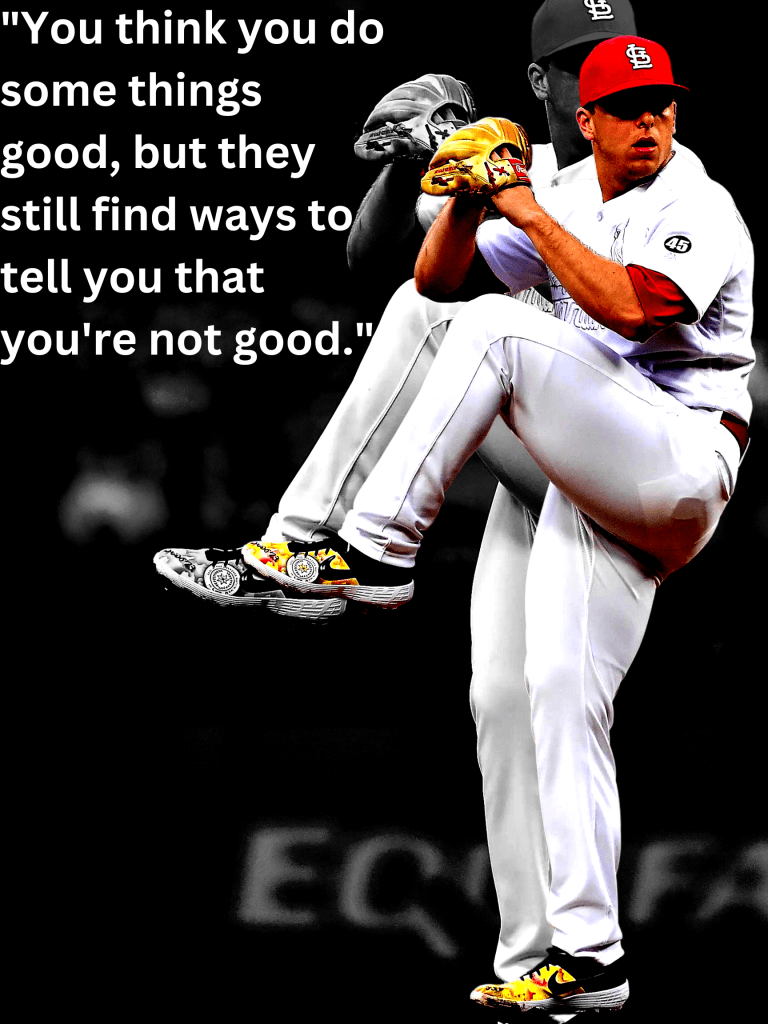
Whatever Ryan Helsley decides for his next hearing remains to be seen. According to the hard-throwing righty, “You definitely understand that it is a business, and I respect that part of it…It was definitely tough to hear some stuff, for sure. You think you do some things good, but they still find ways to tell you that you’re not good. It’s definitely difficult to go in there and swallow and take that on the chin, if you will.”
He’s not the only Cardinal to feel the sting of the file-and-trial process adopted by numerous teams. Reliever Genesis Cabrera’s hearing came down to one of the smallest–Colin Poche had that dubious honor–amounts in the last 12 years: $200,000. Cabrera shook it off and said it was the next step in his career, although Helsley’s case for a reasonable pay raise had more grounding than Cabrera’s.
Among his peers, Helsley’s not the latest MLB star to voice their displeasure with the arbitration process. Corbin Burnes, a 2021 Cy Young winner, and a top 10 finalist this past season, filed for $10,750,000. The Brewers filed for $740,000 less, won their case, and in the process created a fair share of acrimony between themselves and their ace pitcher. Burnes stated, “There’s no denying that the relationship is definitely hurt from what transpired over the last couple of weeks…You kind of find out your true value.”
Hey if it wasn’t clear how the Brewers view star players, look no further than how they alienated their locker room this past season by shipping out all-star closer Josh Hader, or how they punted outfielder Hunter Renfroe to the Angels for Janson Junk and some other relief pitchers, we guess because Renfroe was arb-eligible this off-season which he filed and won $11,900,000 against the Angels. The Brewers are an organization in a long line of middling small market teams who use the Uniform Player Contract to its fullest, whether that be through service time manipulation or using a broken system such as arbitration to suppress wages for baseball’s middle class. They’re certainly not the worst; teams like the Braves, Rays, Marlins, and Astros have squeezed players for millions in stolen labor. Every team is marred by this system that, just in the last 12 years, has garnished billions of dollars in wage theft.
Arbitration as we know it didn’t come into effect until the 1985 CBA. It had existed in some form of the other, but Major League Baseball and their ownership groups wielded all that power. In 1883 the National League implemented the “reserve system” which will eventually become the reserve clause. Under the reserve clause/system a player is permanently bound to the team they’re contracted to. No communication or negotiation between player and other teams. After merging with the American League in 1903 the reserve clause was challenged by the Federal League, who began to sign players away from the MLB.
MLB paid off the Federal League owners to disband their league in 1915, they were then sued by the Baltimore Terrapins which culminated in the Supreme Court case Federal Baseball Club of Baltimore, Inc v. National League of Professional Baseball Clubs, which upheld that the Sherman Antitrust Act wasn’t violated. About thirty years later George Toolson falls on a grenade when he, a minor league pitcher, refused to report to the Binghamton Triplets, a AA affiliate for the talent-rich New York Yankees. Toolson argued that he was good enough to play on a MLB team, but couldn’t since the Yankees owned him. He lost. This is mainly because MLB wasn’t subjected to regulation because, in the Supreme Court’s opinion, they weren’t beholden to the Commerce Clause. We can argue the histrionics of what exactly is interstate commerce and if baseball, a sport that spans across 18 states (we’re counting DC as so should you) and 4 time zones, would fall under that umbrella, but the gist of it is that MLB was given an antitrust exemption and backed by the Supreme Court twice, and that the only way to break that would be Congressional legislation.
Okay, so Congress is not going to happen. At least for a while. Even today the United States Congress can’t establish consistency when enforcing antitrust laws against MLB. Baseball owners are going to violate the Sherman Act numerous times and get away with, but also not get away with it. Most recently, under the leadership of Tony Clark, the MLB players union has incorporated minor leaguers into the fold, a Democrat-dominated Congress had MLB submit information on their antitrust exemption, the Justice Department asked for a narrowing of this exemption which was shot down on precedent. Oh, and then there was H.R. 5580 or the Save America’s Pastime Act that sought to exempt minor leaguers from minimum wages, and Miranda v. Selig that argued that MLB clubs collude and suppress wages and violate antitrust laws, but that court case was shot down in the 9th circuit and the Supreme Court declined to entertain it, and better yet there’s the Curt Flood Act of 1998 which did apply antitrust laws to MLB players, but not minor leaguers. Anyway if all of this is confusing that’s the point! MLB and the federal government’s relationship is a big fucking mess.
And you might be thinking yeah that is a mess, these guys should form a union! The first attempts at unionizing baseball players can be traced back to 1885, but the MLBPA we know and love was founded in 1956, although it served more as a fraternal organization than a labor force.
In 1966 the MLBPA hired Marvin Miller, the United Steelworkers principal economic adviser and one of their respected negotiators to lead them, which he promptly did by unionizing them. Miller got to work striking up a CBA that increased player salaries from $6,000 to $10,000, he also established a grievance arbitration procedure, however the final say came down to the commissioner, and after moving the needle slightly in 1970 formed the basis of what we’ll have today with the 1973 CBA. Under that players with at least two years of service time could submit their salaries for arbitration to a judge.

In the meantime we have a lot of cool and/or goofy shit going on. Curt Flood falls on perhaps the biggest grenade by blowing up his career to try and kill the reserve clause. Flood was traded by the St. Louis Cardinals to the Philadelphia Phillies, who were not a good team and had racist fans. Flood was a Cardinal for the past 12 years and had a business in St. Louis, he did not report to Philly instead filing suit against MLB stating that the reserve clause violated the Sherman Act because it was a collusive price-fixing racket that treated players like chattel. Flood lost his case, but not before laying the groundwork for some of the more goofy stuff to come through.
The first chip to fall comes in 1974 when Hall of Famer Catfish Hunter signed a two-year $200,000 contract with Charlie Finley’s Oakland Athletics. Hunter’s contract stipulated that $50,000 payments be made to a life insurance annuity of his choosing, and when Charlie Finley found out he’d be taxed $25,000 for doing so he refused and breached the contract. Arbitrator Peter Seitz ruled in favor of Hunter and declared him a free agent.

The killing blow comes a year later when Andy Messersmith and Dave McNally decide they’ve fulfilled all contractual obligations to their clubs and wished to leave. Peter Seitz is handed the case, he rules in favor of both pitchers, and is summarily fired by MLB the next day. The owners spent the next three months trying to appeal Seitz’s decision, but they ran out of steam and struck up a new CBA in 1976–after implementing a 13 day lockout in the process.
The reserve clause dies a horrible death and the players are free. Marvin Miller strikes a deal for free agency after six years of service time–as well as a very bizarre re-entry draft that gives teams the rights to negotiate with players–and for 12 years the new status quo was 6 years for free agency, 2 for arbitration. In 1985 that number was raised to three years, in 1990 players would gain an extra year of service time if they were in the top 17 percent of games played at their position and had two years of MLB service, referred to as super-twos. And that’s basically it until 2012 when that 17% goes to 22%.
Prior to what we have today, arbitrators were hired and fired at the behest of the MLB owners. Peter Seitz, who twice ruled against the ownership class, was served his walking papers after essentially freeing players from decades of wage slavery. The two year service time to require arbitration was such a thorn in the side of owners that they spent the better part of a decade working to get that increased, and after that conducted several questionable practices that are maintained today.
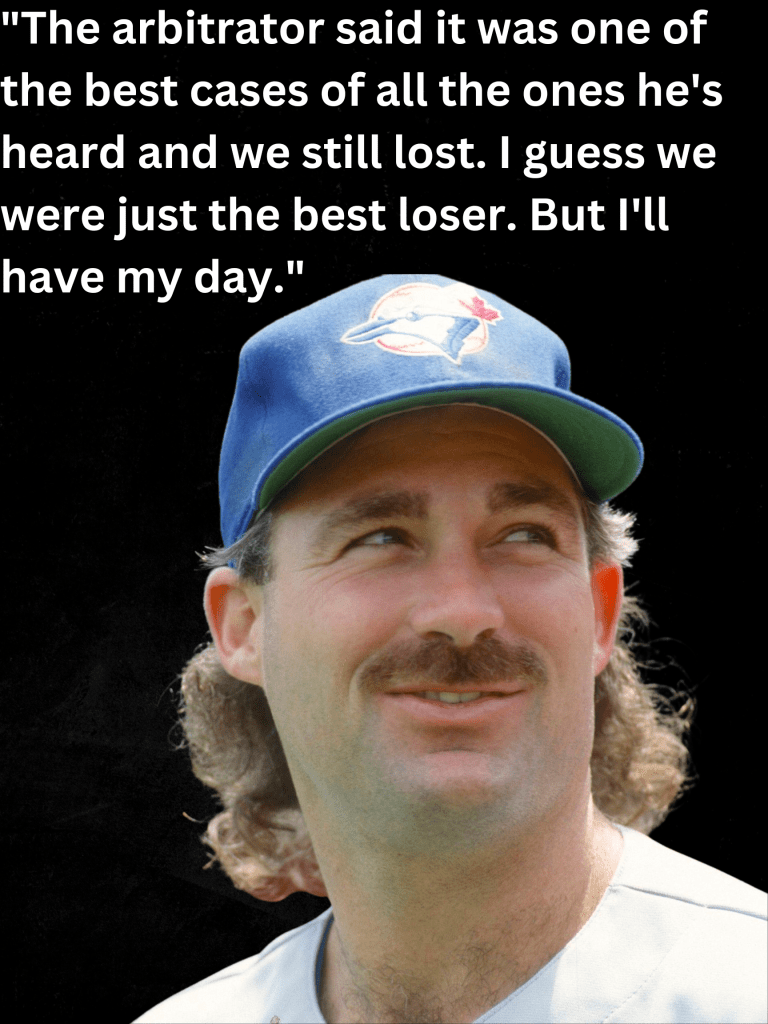
The process of arbitration is a grueling one between team and player. While it’s impossible to quantify this, there are numerous cases historically about fracturing relationships. Dave Stieb is a prime example in the early 80s. Despite being the lowly Blue Jays’s best pitcher–as well as concocting the beginnings of a Hall of Fame worthy career AND stats that would make him the most valuable pitcher of the 1980s–Toronto’s ownership refused to give him the $75,000 raise he was seeking. Both sides filed and went to arbitration. Despite sporting metrics that portrayed him as above average to good, the Blue Jays cited his poor win-loss record (31-33) during that time. This in spite of Stieb pitching for a team that won 157 games in that span, scoring the second fewest number of runs (1,552), and providing an abysmal 2.80 run support in his arbitration year.
The arbitrator stated that Stieb had one of the best cases of all the ones he’s heard, despite that Stieb still lost his case. In response to MLB and the Blue Jays undercutting him he said, “I guess if I had won I could say I’d already had my day. Now having my day would be to get out of there. I just want to get out of this organization…It’s not terrible money, it’s not going to break me, but I thought I was worth more to the team. I wasn’t asking for the world. I was just asking for a fair raise.”
Stieb would eventually remain with the Blue Jays for virtually his entire career. Advanced analytics weren’t favored by sports writers and ownership like it is now. Despite the surge of sabermetrics, baseball still maintains an archaic approach to evaluating a young player’s worth. What is admissible evidence is player health–physical and mental and listed as “defects” in the CBA–leadership, public appeal, prior compensation, past compensation for comparable players, team performance, and stats available through subscription based sites, with the CBA citing Baseball Prospectus. What is not admissible is drawing comparisons to how other sports pay young players and use of performance driven data such as Statcast.
Kyle Tucker, who lost his arbitration case over $2.5 million, was miffed by his decision. He hadn’t asked for much, $100,000 more than Pete Alonso, and $400,000 less than MVP Vladimir Guerrero Jr. received. Tucker whacked 30 home runs, stole 25 bases, drove in over 100 runs, posted a 128 OPS+ in a season where league-wide offense cratered, saved 14 runs and 3 outs defensively, and won a Gold Glove. The 26 year-old 1st rounder has been in the Astros organization since 2015 and is one of the top outfielders in the game today.
Oh and the Astros won the World Series this past year. Team performance and all. Manager Dusty Baker–who once held out in Spring Training as a player when the Braves threatened to cut his salary–spoke highly of Tucker as being an integral piece to the team’s success, referring to him as a “five-tool player and there aren’t many around.”
Didn’t matter, Tucker lost his case and will instead make $5,000,000 this year instead of $7,500,000. Astros GM Dana Brown echoed that there were no hard feelings between the team and Tucker, but the perennial all-star–while trying to hide his ambivalence–admitted that while the process is what it is and that he’ll put this behind him, he shed some of the veneer publicly when he stated what is the growing problem of salary arbitration: “It was tough in that aspect of, you put in all that work and you value yourself a certain way and the team values you differently.”
So the way an arbitration hearing works is that a player and their representation–their agents–sit across from the organization and MLB appointed counsel. There are three judges, one appointed by MLB, the MLBPA, and a third a judge promoted by the MLBLRB (MLB Labor Relations Board). Players present their case, followed by the club, then a player rebuttal, and a club rebuttal. Both sides have the option of a sur-rebuttal, but after that the panel of judges take all this in and rule for one side or the other.
Arbitration detractors like to point out that the player going first puts them at a disadvantage. While arbitration is not designed to put anyone on the defensive, having the player start off the hearing is considered placing the onus on them rather than both sides presenting a case to a supposed neutral counsel.
There’s also the issue, according to Tucker’s agent Rick Shapiro, of MLB and owners contradicting what they value in the game. With the onset of the new rule changes designed to encourage faster pacing, more balls in play, and stolen bases, MLB–according to Shapiro–stated that Tucker brought none of these tools to the game: “Representatives of the commissioner (outside counsel and a league official) sat across the table from Kyle Tucker and said none of the tools you bring to the game, none of the athleticism, none of the base-running, none of the Gold Glove defense, none of that matters in salary arbitration. If you want to get paid at the top of the mark, you need to hit home runs, and only home runs.”
It’s worth repeating that Kyle Tucker hits a lot of home runs.
There’s also Dellin Betances, the electric reliever known for his time with the Yankees in the mid 2010s. From 2014-2016 Betances carried a 1.97 FIP to go along with a 14.3 K/9. He struck out over 40% of the batters he faced (3rd best in the league during that span), threw the most innings for a reliever, and had the highest fWAR in those 3 years. Betances would have been the Yankees primary closer if they did not already have Aroldis Chapman.
At his arbitration hearing Betances asked for $5 million, the Yankees filed for $3 million and won. It was the first Yankees arbitration case to reach a hearing since Chien-Ming Wang in 2008 (which the Yankees also won). Despite winning the case, Team President Randy Levine held a video press conference to state that Betances’ hearing was an outrageous and “half-baked attempt” to reset the market for relief pitchers. Levine said Betances might as well have been asking for $50 million. He also said that “$5 million goes to elite closers. Pitchers who pitch the 9th inning and have a lot of saves. Dellin didn’t have that record. He never did.” If you didn’t already hate this guy, Levine didn’t even know Betances name referring to him as Dylan instead of Dellin.
Worth noting that Betances saved 22 games and recorded 78 holds during that time (2nd most in the Majors). His 108 inherited runners was 14th in the league and his 81.3 LOB% was 23rd among 163 qualified relievers.. He recorded only 13 blown saves.
Despite these sterlings superlatives, the Yankees cited Betances slow delivery to the plate which saw base runners steal a perfect 21 for 21 off of him. Whether that had an impact on the arbitration ruling is conjecture at this point, one of the principal criticisms of these hearings is that judges do not issue any explanation on why they rule the way they do–which would undermine ownership, as now there’d be written precedent to go by.
Betances was none too pleased on the matter. In a press hearing he’d state, “They take me in a room, and they trash me for about an hour and a half. I thought that was unfair for me. I feel like I’ve done a lot for this organization, especially in these last three years. I’ve taken the ball time after time. Whenever they needed me, I was there for them.”
The Yankees never even entertained meeting Betances in the middle, a feature that the final offer arbitration is supposed to encourage. It’s becoming more common to file and trial in baseball. Since 2017, there have been 98 arbitration hearings with the owners winning 56 of them. From 2011-2016 there were 31 hearings with owners winning 17.
Historically, arbitration hearings have featured salary disputes as low as $100,000 (Mike Foltynewicz, 2018) and as high as a couple million. Tucker’s $2.5 mil was the highest since Mookie Betts’ $3,000,000 dispute with the Red Sox in 2018. Since 2011, players have asked for $612,800,000 in salary compensation, the owners have offered $525,760,000. A total of $564,610,000 have been awarded in arbitration, with the owners taking the lion’s share at $284,035,000. You might see that slight majority as a sign of equality, but keep in mind that the owners won 54% of the amount they have historically filed for, the players have won 46%.
Here’s where we’re gonna start talking about some ugly stuff. Some of you are probably reading this and going, “So what? They’re millionaires. Sure they’re millionaires paid by billionaires, but I’m not gonna cry over someone becoming rich playing a game.”
You can feel that way, but I’m going to ask you to put that aside or reevaluate how you feel about a 25 year-old man making a couple million. I’m gonna ask you who you go to see at the ballpark; Do you go to see Bill DeWitt or Tom Ricketts or Steve Cohen? What compels you to buy a baseball ticket, and devote either an entire evening or afternoon in preparation, money, travel, and concessions.
Now what is that worth exactly to you to maintain? What is it worth that the people who provide that entertainment for you be compensated fairly?
It’s hard to dictate how much a player is actually worth. Bleacher Report and Fangraphs have a calculation to determine how much value a player produced based on their Wins Above Replacement. Fangraphs VALUE isn’t designed to show you how much a player should be paid, but rather what a team would have to spend to replicate their production. Take for example Chone Figgins in 2009 posting a 6.1 fWAR and his production being valued at $27.4 million. No one’s gonna pay Figgins that amount, however we can use it as a guide to see the difference in what a player provides and what he’s compensated for. That season, Figgins made $5.775 million, in free agency he netted a 4 year $36 million contract from the Mariners. While different than in 2009, a single Win Above Replacement is valued around $8 million.
Owners, in a lot of cases, recognize some of this valued importance. Or better yet, don’t want to risk losing an arbitration case that tilts the scale more in the players’ favor. Phenom Shohei Ohtani netted the fattest arbitration settlement at $30 million, surpassing Mookie Betts’ 2020 mark of $27 million. Owners are more likely to go to war with baseball’s middle class over pennies than established superstars. When the Red Sox took Betts to a hearing in 2018 he won his case.
Arbitration’s final offer process works in ownership’s favor too. Despite massive payouts to players like Betts, Ohtani, Bellinger, and Degrom, MLB teams are getting these players during their prime years at a premium. The fear of a final offer contract encourages negotiations, but also unfair buyout contracts. The Atlanta Braves are perhaps the most notorious of these teams, buying out the arbitration years of Ozzie Albies, Ronald Acuna Jr, Sean Murphy, Austin Riley, Michael Harris II, and Spencer Strider. For Albies, an all-star and one of the best middle infielders in the game, the Braves signed him to a 7 year $35 million contract. Acuna Jr., an annual MVP candidate, signed for 8 years $200 million after his Rookie of the Year campaign. Riley got 10 years at $212 mil, Murphy 6 and $73 mil, Harris II 8 years and $72 million, and Strider 6 years at $75 million.
All of this is big money and guaranteed cash for incredibly talented players in the pre-free agency years. What the Braves are doing, however, is mitigating the rise of future salaries for talented players in the future. The Pirates did this with Ke’Bryan Hayes, the Rays with Wander Franco, and the Mariners with Julio Rodriguez. This doesn’t always pan out the ways owners think it does, sometimes players bet on themselves like in the case of Aaron Judge who turned down a 7 year $213.5 million extension, instead taking his $19 mil in arbitration, slugging 60+ home runs, and earning a payday with an extra $100 million guaranteed.
There are other cases too, some more infuriating as it shows evidence of collusion and retaliation. MLB has a problem with service time manipulation, a feature in the capitalist system that the owners have designed for themselves. A player must accrue 3 years of MLB service time. A year of service time is 172 days, the problem is these days do not carry over. Take for example Kris Bryant’s infamous manipulation case that saw the Chicago Cubs start Mike Olt for the first couple of weeks before calling their future MVP up. Bryant racked up 171 service days in his rookie year, but didn’t earn a year of service time until that following season. Bryant filed suit with the player’s union but lost. George Springer turned down a 7 year $21 million extension to buy out his arbitration years with the Astros. Houston then sent him down for a few weeks as punishment, before calling him up. This tactic delays free agency and arbitration for players by a year–sometimes more, as is the case of pitcher Justin Grimm who debuted in 2012 but wasn’t arbitration eligible until 2018–and keeps them under team control. To Springer’s credit, though, he’d get the last laugh when he took $21 million in an arbitration settlement in 2020.
From 2011 to 2023, players that went to hearings had generated 241.6 fWAR in their arbitration year. Using Fangraphs VALUE calculator, these 131 players produced $1.896 billion in labor. 94 of these players are still active today in some form of the other; 4 players have minor league contracts and 5 others are current free agents. 37 are out of the league completely, with most of them retiring prior to the 2017 season.
The current life expectancy for these arbitration players is in line with the league average; about six years and some change, with that number climbing in recent seasons. Being a major league baseball player is pretty hard and whenever you start is pretty important. Players careers were pretty short through the first half of the 1900s with the average major leaguer lasting just over 4 years. A lot of that had to do with baseball’s unfair labor practices for the time. The starting salary for a ballplayer in 1967 was $6,000, nowadays it’s $720,000. Players coming through the Dead Ball Era and through the Golden Era would just retire because they could make more money elsewhere. From 1969 to 2003 the average service time was around 6.85 years. If you started playing ball in your early 20s you could expect a healthy career, usually between 6 and 9 years, but if you broke into baseball after your age 24 season your career is likely to be a third of that time.
There’s also the importance of reaching 10 years of service time, a feat that only 10% of the league reaches. At 10 years of service time MLB players qualify for a full pension, which they can begin drawing at age 45 and receive $68,000 annually. That number can slide higher if a player decides to draw later.
There’s so much on the line for these guys. This is money they have to stretch out their entire life, with some being lucky to make it to arbitration. The average big leaguer salary rose to $4.22 million this past season, but a lot of that increase came from a free agency class that netted an annual average of $14,851,095. Orioles Brad Bergesen made it three years and was done, his final take home being just over $2 million, in his only arbitration year he asked for $1.2 million but lost to the Orioles mark of $800,000. There’s Jarrod Parker, a talented first rounder whose career derailed due to injury. In his short 3 year career as a big leaguer he generated almost $35 million in labor, but was only paid $5,689,000.
In fact only a handful of guys have really taken more money than they were worth. You’ve probably heard fans bitch about that kind of thing–Greg Holland comes to mind as a Cardinals fan–but those instances are incredibly rare. These 131 players generated over 1,304.6 Wins Above Replacement for their careers, a total VALUE of $10,163,400,000. They were paid less than a third of that amount ($3,273,660,211). Some players, like Jerry Blevins (90.02%) and Adeiny Hechavarria (85.56%), made close to what they produced, some players fleeced their teams (Mark Trumbo, Jose Veras), but nearly all of them were screwed in some form or the other. Marlins pitcher Pablo Lopez has made just under 6% of his labor value, Kyle Tucker 6.59%. Even superstars like JT Realmuto, who went to arbitration twice, have been vastly underpaid; Realmuto has made just over a fifth what he’s provided to both the Marlins and Phillies, Gerrit Cole less than 40% of the $300+ million in VALUE he’s generated, Mookie Betts has made just over 22% of what he’s created. Corbin Burnes has generated over $114 million in VALUE for the Milwaukee Brewers, who took him to arbitration over $740,000 only to pay him less than 8% of his labor.
Arbitration is not perfect, but shouldn’t go away. The current MLBPA stance is very pro-arbitration. Despite the balance of power often swinging in favor of the owners and MLB, arbitration, historically, has helped the free agent class in attaining higher wages. It’s also served for talented players to catapult themselves into life-changing money, or open negotiations for teams to offer life-changing extensions–I wouldn’t say “leverage” for the player here, considering that all the leverage in the arbitration process still greatly favors the owners.
Arbitration was such a pain in the ass that owners tried to kill it, and when they couldn’t kill it they received concessions for it. This past CBA owners proposed eliminating arbitration altogether instead going with a WAR based formula, or a set age before free agency. You can see why this would be a problem–especially for utility players and relief pitchers–and if they got their way for a set age of 28–imagine the next Bryce Harper debuting at age 20, and having little to no bargaining power for the next 8 years of their career.
There have been considerations to changing the format. There have been suggestions made for service time manipulation as well. One of the best arguments is adopting the arbitration process done by the NHL, which doesn’t have a final offer arbitration. Instead, a panel of arbitrators rules what they deem fair between a team and a player. This written ruling can decide either the player or team’s offer, or a figure in between. If teams disagree with the decision they can exercise their “walk away rights” and the player effectively becomes a free agent.
It’s something that MLB would not go for. For one, written decisions become established precedent, and while that would cut down on so much time for hearings, the last thing owners want is a big arbitration win being the new reset point. Remember Dellin Betances’ request and how Randy Levine treated it not as an affront to the Yankees’s checkbook, but as a threat to the status quo on what is a reasonable market rate for a good relief pitcher. Eliminating final offer arbitration also takes away the leverage a team has if a player wants to be brazen enough to demand what they’re worth. Take this for example: a player of Kyle Tucker’s pedigree submits for a salary of what he’s worth, or better yet what he’s near-worth, of about $25 million. Knowing that the most recent precedent for a player similar to Tucker’s metrics was a fifth of that, the team may counter with $5 million, or more or less. And with that precedent they could present that, as part of admissible evidence under the CBA, at the hearing and undercut this player by however many millions they want to.
What is ugly and terrible about the arbitration process would be made only more hideous with its removal. What it needs is an overhaul that will require more struggle and incremental victories by players and labor. In its current form, MLB owners benefit largely by winning the majority of their hearings. Despite rising salaries among its players, MLB teams still vastly underpay their young and promising stars, as well as their most impacted players–lower to middle class role guys. MLB and organizations do not care how much it pisses off their players; it’s a business after all, and although these tensions could be avoided with either fairer compensation for labor provided, or a complete rehaul of the methodology used to reach these conclusions; the truth is that arbitration is just another facet in the lie that baseball owners tell us. That the game is not profitable, and that players have too much power, and that they make too much money. Owners, like Bill DeWitt, never pause to remove its mask and show us what it really is; just another hideous form of wage theft carried out by robber barons who treat and value human beings like cheap plastic toys.
 Home of The Worst Fans in Baseball Podcast
Leave a comment