
By Tom
Hey that Jordan Walker guy sure is getting a lot of hype recently.
In case you’ve been living under a rock, Walker is the 4th ranked prospect on Baseball America and mlb.com. He possesses tremendous power and a plus arm, as evident by his 99.5 mph laser in this most recent AFL. He is huge, six-five and 220 pounds of pure steel; he had the top four exit velocities in the Arizona Fall League. The Cards took him 21st overall in the 2020 June Draft initially as a third baseman, however the subsequent trade for Nolan Arenado in the following offseason shut the door for Walker at the hot corner, so he learned to play outfield this past season where he showed off that aforementioned rocket arm and some incredible adaptability. Walker posted a solid range factor and committed only two errors in 295 innings of work at a new position.
He is, without a doubt, a very special player. And before we delve into all the nerdy historical stuff, here’s a couple of statistical morsels to whet your appetite. Walker hasn’t hit below .300 in a full MiLB season yet, despite concerns about his strikeout rate when he makes contact he usually barrels it up. In his age 20 season he slashed .306/.388/.510 at double-A Springfield, hammering 19 homers through 119 games. He’s not just a power threat, he tallied 235 total bases complimented by his 31 doubles and 3 triples, and because it never hurts to show off the wheels, he swiped 22 of 27 bases and scored a league-leading 100 runs. Despite the 116 Ks, he still drew 58 walks (10.8 BB%); his 128 wRC+ not only led Springfield but placed him 5th in all of Double AA behind players 3 to 7 years older than him; he batted .300 or more in every month except July (.290), he fared well against righties (.912 OPS) and lefties (.851 OPS), batted .333 in the 7th inning on, and hit well at the top and middle of the order. If there’s any weakness in his splits it’s his RISP, where he still posted a serviceable .765 OPS in 161 plate appearances.
Most importantly, and this is the most vital metric Jordan Walker excels in, he is cool as shit.
Now that you know Jordan Walker is really cool and good at baseball, let’s go look at some first round picks, both at the MLB and organizational level, as well as the latest fanfare to come out of Cardinal Nation.
There is a ton of hype surrounding Jordan Walker. There is the typical amount that comes with being a first rounder, along with the expectations of a young professional after inking a multi-million dollar signing bonus. Cards twitter user @CardinalsReek–who does an exemplary job of monitoring MiLB player metrics–pointed out in December that Walker’s exit velocities were consistent with Juan Soto’s. Viva El Birdos has picked up the Walker reporting as of late, along with the St. Louis Post-Dispatch’s Daniel Guerrero, who said that Walker “will come into camp with a chance to crack the opening day roster” and reported GM John Mozeliak’s shared excitement:
“In Jordan Walker’s case, obviously he’s a dynamic player,” Mozeliak said on Saturday to fans inside Ballpark Village. “I think the biggest thing for him is just playing the game, just gaining experience. If we’re patient with that, he’ll benefit from it. I think we’ll all benefit from it. He has a chance to be a household name very, very soon and put his fingerprints on the St. Louis Cardinals quickly.”
This is in no way a knock against VEB or Guerrero. They are simply reporting the same reality we’re all experiencing–in that Jordan Walker is awesome and cool, have I mentioned that? A lot of Cardinals Twitter have reacted to the hype as well, and this piece was inspired by a series of polls put out by Cards prospect expert Kyle Reis.
Understand, this is not a phenomenon that the fans are excited about an immensely talented young player, this same player who hit so many piss missiles in the AFL that it warranted experts to tout him as a top 5 prospect with a 60 future value. I’m not sure when the Walker hype train began its full-steam journey; there was this November interview with former GM and ESPN analyst Jim Bowden, who referred to Walker as a superstar. Perhaps it was his ascent in the national prospect rankings, or Guerrero’s reporting–Walker’s name spiked on Google trends a couple days after–or maybe a series of polls asking hypotheticals such as: Would you rather have Mike Trout through his 30s or Jordan Walker his whole career? If Jordan Walker had the same career as X would you be satisfied?
Speaking of satisfaction, the lack thereof is probably the coal fueling this locomotive. Cardinals fans forget about the positional logjams they have at their corner infield spots, but perhaps where it’s just as worse is in the outfield. They had a similar problem with pitching talent in the mid to late 2010s, with the solution being finding the guys they were biggest on–Jack Flaherty, Alex Reyes, Dakota Hudson–and trading the guys they deemed expendable–Zac Gallen, Sandy Alcantara, Marco Gonzales. We can probably expect something similar to pan out here, as prospects like Alec Burleson and Juan Yepez have shown they’re ready for the show, the latter proving this past season he can hit at this level. The Cardinals saw limited offensive production from 1st round darling Dylan Carlson who posted a league average 100 wRC+, but dropped 95 points in OPS. The same with Tyler O’Neill who put MVP numbers in 2021 and was the best left fielder by fWAR; O’Neill carried a 101 wRC+ through 96 games and lost a step defensively. Former center fielder Harrison Bader was shipped to the Yankees for Jordan Montgomery, taking with him his defensive superlatives but also his league average bat.
You’re probably already aware of something I’ve left out when it came to Carlson, O’Neill, and the departed Bader. They were all hurt last year, with Carlson gritting out his injury and staying on the playing field. Bader’s shipment freed up center for Dilly-Dong, which freed up right field for Lars Nootbaar whose production and metrics has Cardinals fans oozing just as much hype. Juan Yepez filled in, as well as the versatile Brendan Donovan, and they all performed well enough to be big leaguers.
The front office has a much longer leash for Carlson and O’Neill. Take, for example, their patience with Paul DeJong before optioning him to Memphis to straighten his shit out. And then they brought him back where they kept him even though he was far worse. If they’re that patient with someone like PDJ, you can bet that they’ll exude that same caution when it comes to a) a first rounder, and b) a player they traded a first round pitcher for. Walker also has Burleson ahead of him too, who may have hit .188 in 48 MLB at-bats, but absolutely tore shit up in AAA slugging 20 homers and a .532 slugging, to go along with 14.2% K rate, and a .905 OPS.
While impressive, it’s not that Walker’s numbers are historical anomalies; I want to be clear about that, there are other 1st round prospects we’ve had that have performed with similar stats in the last 20 years:
- Nolan Gorman: Drafted 19th overall in the 2018 draft, Gorman put up modest numbers his first two professional seasons before taking off in 2021. He slammed 25 homers and posted a .814 OPS at AA and AAA. Last season he came in as a top 35 prospect and battered 16 homers in 43 games in Memphis, slugging .585 and carrying a .915 OPS. The Paul DeJong woes earned him a promotion where he slashed a admirable .226/.300/.421 in 313 plate appearances, despite that he was optioned back to AAA on September 19th.
- Dylan Carlson: Carlson was taken 33rd in the 2016 draft at a discount–the Cards signed him for $550,500 under the slot value–he started off slow in Rookie and low-A ball, but he was 17 and 18 at the time. By his age 20 season Dilly-Dong had a .914 OPS between Springfield and Memphis, posting a 1-dot (1.098 OPS) in 18 games in AAA. He was promoted from the taxi squad during the Covid year where he struggled for most of the season with a .616 OPS, but his full rookie campaign in 2021 saw him slash .266/.343/.437 and carry a 2.6 fWAR. Last season a battered Carlson took a step back offensively, but improved his defensive metrics so much so that he still posted a 2.4 fWAR.
- James Ramsey: The 2012 first rounder took a season to get going, but posted a .814 OPS in 2013 and a .890 OPS in 2014. The latter of which had him slashing in .300/.389/.527 in AA before being shipped to Cleveland for Justin Masterson, where he churned out a .833 OPS in AAA before ultimately regressing to the point he’d be out of professional ball by 2019.
- Brett Wallace: lol, oh man. The 27th ranked prospect by Baseball America at one point, Wallace was the 13th pick in 2008 where he soared to double A in his first season. In 54 games he batted .337 with a .530 slugging. In that following AFL he posted a .966 OPS in 24 games, the following year at AAA his power regressed but he still batted .293. Wallace was on enough peoples’ radars that he was shipped to Oakland in the Matt Holliday trade, where he was then traded to the Blue Jays for Michael Taylor–not that one–before being traded to the Houston Astros where he’d finally break into the bigs in 2010.
- Colby Fucking Rasmus: Remember this guy? Of course you do, I still see him and Tony Rasmus in my nightmares. Colby carried a .932 OPS at double A Springfield in his age 20 season. He walloped 29 homers and walked 12.6% of the time. In 2008 he slashed a pedestrian .251/.346/.396 in AAA before making his big league debut in 2009. He was out of St. Louis two seasons later.
- Daric Barton: A top 30 prospect by the time we traded him. Barton had a .843 OPS in his age 17 season. At low-A ball he bashed 13 homers, drove in 77, posted a .313 average, and posted a .956 OPS. We naturally flipped him to Oakland for Mark Mulder where he’d enjoy a couple seasons in Oakland, including a standout 2010 that saw him lead the league in walks.
And these are just first round picks. 2nd round catcher Todd Zeile never mashed below a .836 OPS in the minors. 4th round pick Paul DeJong hit .909 in rookie and low A ball, got promoted to AA where he hit 22 bombs, and then immediately jumped to the majors and got Rookie of the Year votes.
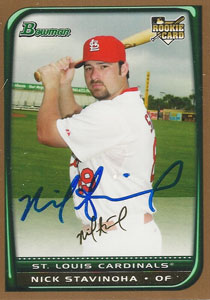
7th rounder Nick Stavinoha, FUCKING NICK STAVINOHA, hung an .884 OPS in Memphis before getting 29 games with the Cards. Allen Craig was an 8th round pick who posted back-to-back .300 average and .540 slugging seasons in Memphis. And to steelman Walker’s position as a perennial star, there are plenty of big leaguers who didn’t need to slug as high as him who turned out pretty good–Coco Crisp, Lance Johnson, Jack Wilson, Vince Coleman, Tom Pagnozzi. Hell, Albert Pujols was fast-tracked to the league and he played most of his minor league games in low and high A ball.
It should probably go without saying that the game of baseball has changed, and that these players had different arcs and differing levels of performance and consistency, and that if we squint hard enough we’ll find that Jordan Walker is more unique than these guys–first rounders too, I did not have sufficient autism to wade through every draft pick–and I’m here to say that that’s 100% valid, because there’s only one Jordan Walker and from what we know he is very cool and good at baseball.
But…maybe let’s be patient and set our expectations to such. Not for your sake, but for Jordan Walker’s.
There have been 2,046 first round picks since the implementation of the Rule 4 amateur draft. I know because I counted all of them. I also categorized all of them based on their bonuses, bWAR1, Hall of Fame status/worthiness, and whether they were a boom or a bust. I did the same thing with all the Cardinals first round picks too.
Let’s set this next bit up accordingly; historically, Jordan Walker is probably not going to be a Hall of Famer, HOWEVER, if he does, he’s going to be part of a very very elite class of player.
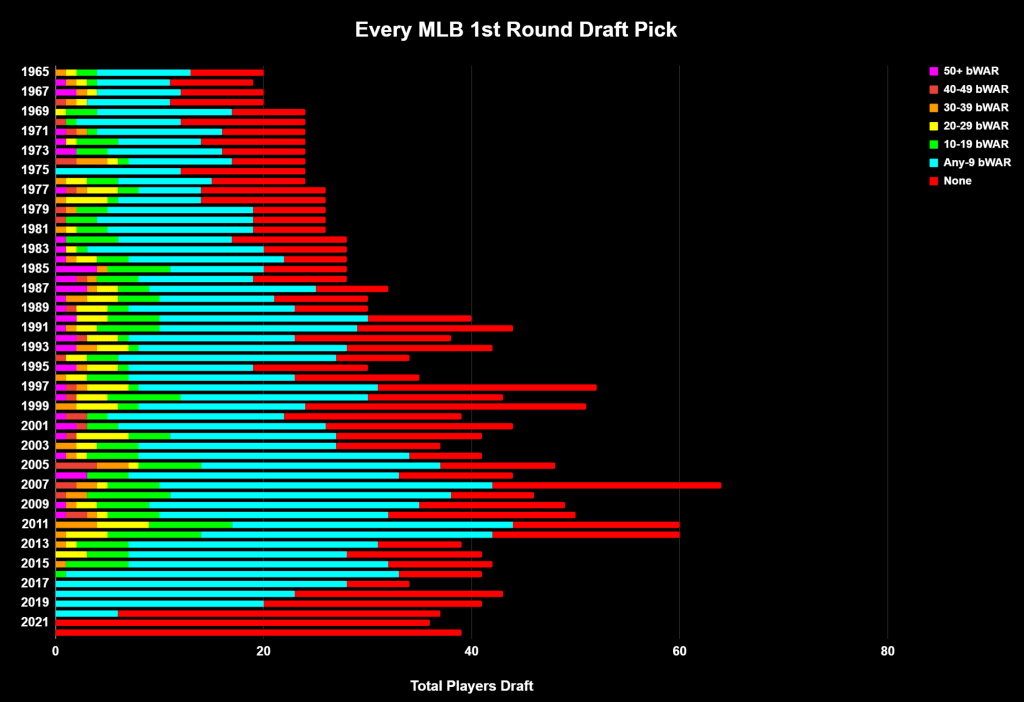
15 first rounders have made the Hall of Fame, the last being Roy Halladay in 2019. Halladay was selected 17th overall in 1995 by the Toronto Blue Jays. By my own standards, there are currently 21 retired or current MLB players who I believe are/will be Hall of Famers. This list includes controversial PED users like Roger Clemens (1983, 19th overall), Barry Bonds (1985, 6th overall), Alex Rodriguez (1993, 1st overall), etc etc you get the gist. I’ve included guys like Todd Helton, who will most likely be elected in next year’s hall of fame class, CC Sabathia, Chase Utley, Joe Mauer, Manny Machado, Mike Trout, and Bryce Harper. Some of these guys could have career blow-ups, but honestly they’re just a few average seasons away from punching their ticket.
Combine those various groups together and, by my estimation, we’re looking at 21 should-be or will-be Hall of Famers. Guys with significant statistical milestones and accolades to their names. That puts us at 36 out of 2,046, a Hall of Fame caliber player about 1.8% of the time or every year and a half.
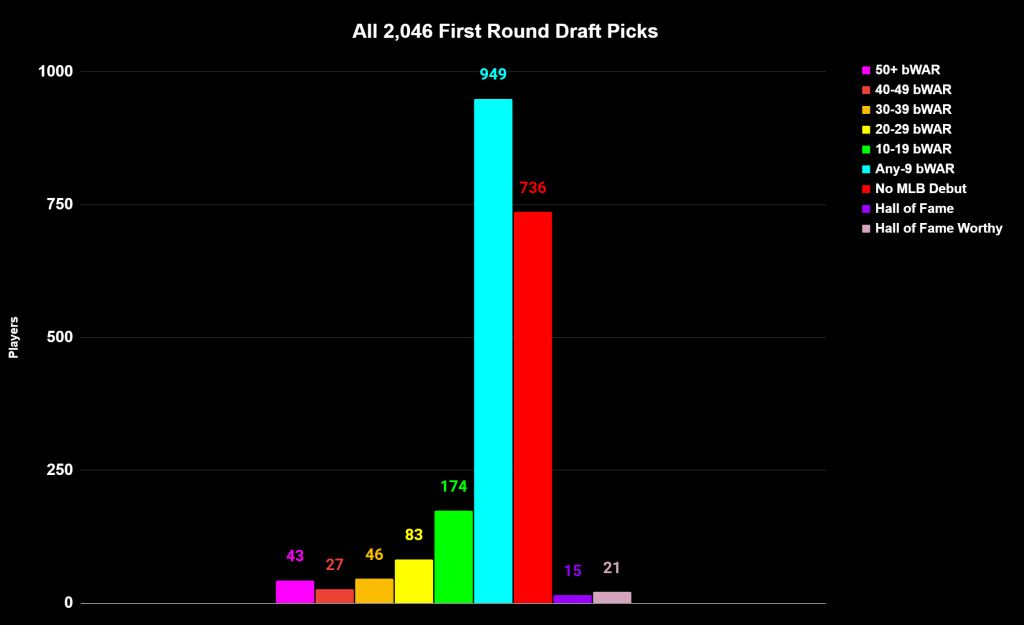
That number shrinks further when you look at the Cardinals, who have drafted only one first round Hall of Famer in Ted Simmons, who earned his way through the Veterans Committee in 2020. The Cardinals have drafted 87 first rounders and produced Simmons, for a going rate of 1.1%, or roughly 1 in 57 years.
43 first round big leaguers have gone on to have incredible careers where they posted at least 50 bWAR. One of the best classes being the 1985 draft that saw Barry Bonds (162.8 bWAR), Rafael Palmeiro (71.9 bWAR), Barry Larkin (70.5 bWAR), and Will Clark (56.5 bWAR). The Cardinals took Joe Magrane (12.0 bWAR), who’d enter the Show two seasons later as part of the ‘87 pennant squad and was, for a very brief window, one of the premiere left-handers in the game before his elbow exploded and ended his promising career.
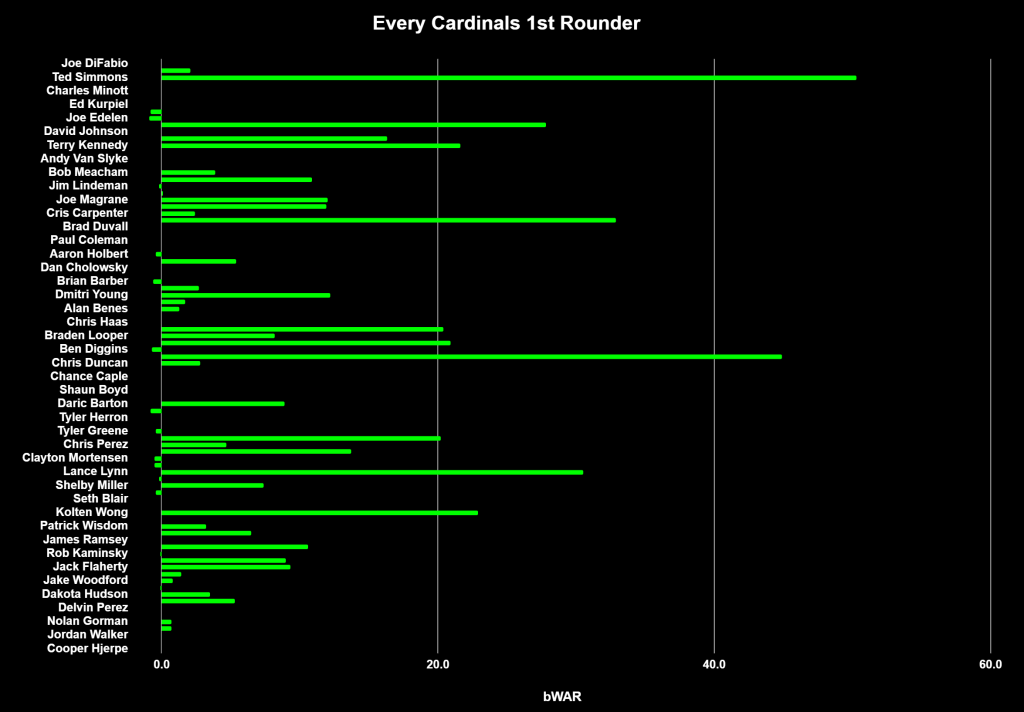
For more of the classics, the 1974 class gave us back-to-back NL MVP Dale Murphy, speedster Willie Wilson, and Tigers great Lance Parrish, the 2005 draft gave us 7 players with 30+ bWAR like Ryan Braun, Andrew McCutchen, and Troy Tulowitzki. For a more modern touch, the 2011 and 2012 classes were stacked with guys like Gerrit Cole, Trevor Story, Carlos Correa, Byron Buxton, Corey Seager, Max Fried, and Lucas Giolito.
Most of those names aren’t or won’t be in the hall of fame. In fact the numbers show that the plurality of first rounders become replacement level/serviceable big leaguers (946, 46.3%), or they wash out entirely (736, 35.9%). Only 18.2% of 1st round picks go on to have 10+ bWAR careers, or to put it another way they’re more likely to turn out like a Gordon Beckham or Brien Taylor, than a Luis Alicea.
Draft signing bonuses have obviously changed historically. First round signing bonuses didn’t crack a million dollars cumulatively until 1972 when Chet Lemon got the fattest check at $78,000. This most recent draft saw over $137 million dollars go to signing bonuses with Jackson Holliday and Druw Jones each receiving sign-ons for over $8 million, however it has not yet eclipsed Spencer Torkelson’s 2020 record mark of $8,416,300.
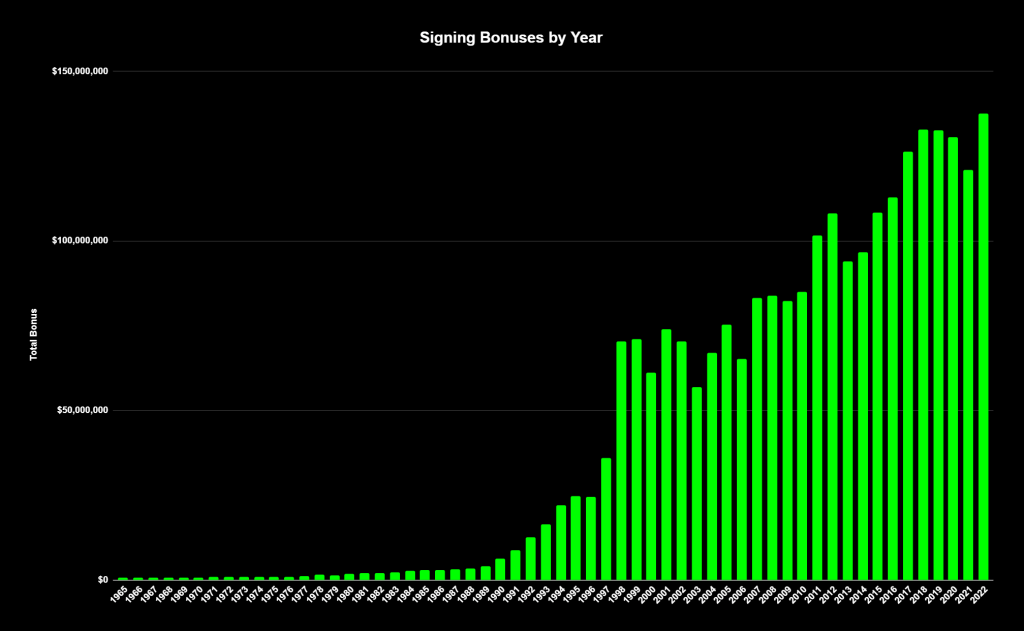
The Cardinals have never come close to matching that amount for a top overall pick. In fact they’ve never had the first overall. Their average picking position is 23rd. The highest they’ve ever picked was in the 1996 draft. It was after a disastrous ‘95 season that saw Joe Torre get fired and a starting staff led by fucking Mark Petkovsek. The Cards took Braden Looper 3rd overall and made him the organization’s first million dollar man ($1,675,000 to be precise). Looper, of course, became a bullpen arm, pitched four games in ‘98 before being traded to the Marlins for Edgar Renteria. He eventually made his way back to St. Louis where he reinvented himself into a passable starting pitcher.
The most money we’ve ever doled out to a first rounder was the $3,231,700 for Nolan Gorman. The runner-up to that number is now left-hander Cooper Hjerpe whom we took this past season. The Cardinals have only recently begun to spend a little money in sign-on bonuses. Until Gorman the fattest stack was the $3 million they paid JD Drew in 1998 (along with an additional $4 million MLB contract). Jordan Walker’s sign-on bonus–I’m sure you’re wondering–was for $2,900,000, a little over $200,000 less than the slot value.
It’s not often the Cardinals lose their ass on a 1st rounder. Delvin Perez got over $2 million only to face PED allegations and hit like someone who wishes they were taking them (he elected free agency after this past season). Prior to Delvin the Cards lost out on…who? Rob Kaminsky? Nick Plummer? From ‘99 to 2001 they drafted 5 players and paid $6,635,000 in bonuses to players who never cracked a big league roster. On the flip side they’ve had consistent runs of “success” like ‘05 to ‘10, or ‘12 to ‘16. They’ve had 31 guys not make a big league roster–so far, this is counting guys like Walker, Michael McGreevy, and Hjerpe–a rate better than league average. 38 of these first rounders went on to crack a MLB roster and produce up to 9.9 bWAR, and a very small amount, 18 guys (or roughly 21%) became Luis Alicea or JD Drew.
There are some interesting guys in this mix. 1991 pick Allen Watson led that aforementioned dreadful ‘95 squad in wins before getting flipped to San Fran for Royce Clayton–TLR fans rejoice–Watson would go on to be implicated by pitcher Jason Grimsely for PEDs, and there’s also this funny story–around the time he was allegedly juicing–where he and some guys were goofing around and he’d beaned George Steinbrenner with a bagel.

Let it show that we support this kind of action against baseball owners (and billionaires in general), but when Watson fessed up that he was the bagel tosser Steinbrenner told him he figured it was him because “that’s why it didn’t hurt.”
There’s also Brian Jordan, who was drafted but didn’t receive a bonus. That’s because Jordan was a pro bowl alternate safety for the Atlanta Falcons. While he was playing in the minors, Jordan would go and play football from time to time. The Cardinals finally gave him a $1.7 million bonus if he’d quit playing football in ‘91. Jordan said yes, played 7 years in St. Louis, and finished his career with a plus-30 bWAR.
Did you know we drafted Dmitri Young in the first round? He punched a heckler in ‘95 while playing for AA-Arkansas. One Cardinals scouting executive said he was going to eat himself out of the bigs. Well Young got traded to the Reds for Jeff Brantley and would go on to make about $48,000,000 by the end of his career so, yeah, sure looks like he ate himself right into a shit ton of cash.
There’s Cris Carpenter, the original one, who was a Georgia varsity standout, playing basketball, baseball, and football for Gainesville High. He went to the University of Georgia where he punted and pitched before the Cards took him 14th overall in the ‘87 draft. He didn’t pan out as a starter but was a decent reliever. When he retired he went back home and the 57 year-old Carp teaches social studies and coaches at his alma-mater.
There’s other famous and infamous ones. Leon Durham who infamously kicked a ground ball in the ‘84 NLCS to help the Cubs lose, but before that he was a 15th round pick and well-regarded by Whitey Herzog who only parted with him in the Bruce Sutter trade because the Cubs demanded him. There’s also Terry Kennedy, a Ted Simmons successor who was flipped in a 10 player deal to San Diego to get Rollie Fingers, who was a Cardinal for about a week before going to Milwaukee to get David Green.
There’s 13th rounder Garry Templeton who went from unmovable player in Whitey Herzog’s eyes to marked man after he grabbed his crotch to insult some fans on Lady’s Day at Busch. He was flipped for Ozzie Smith who ran 8th overall pick Bob Meacham out of a job (Meachem, to his credit, made it an easy choice when he recorded 47 errors at shortstop one season), who was traded along with Stan Javier to the New York Yankees who employed Bob a couple years but mainly used Javier to flip to the Athletics for Rickey Henderson.

There’s Bob Hicks who was taken as a first baseman 15th overall. He sucked at first base so he decided to try out pitching where he also sucked. I tried to find Bob today, but the only results I found were a dead guy and another that likes to run 5ks, and I’m really hoping it’s the latter.
Ummm who else we got? There’s Charles Minott who started off as a left-handed pitcher before getting hurt and then coming back as a hitter who posted a .941 OPS in 61 games and then was done. No shit, he was gone after that. I don’t know why, I couldn’t find any newspaper clippings on him. He just disappeared.
There’s patient zero Joe DiFabio, the very first pick. The Cardinals drafted 60 players in the original draft. Only 5 made it to a big league ballclub. Joe played college ball out of Delta State, was picked up and performed admirably in the minors. But the team had Steve Carlton, Nelson Briles, and Larry Jaster, and despite posting a 3.23 ERA in 688 minor league innings for the Cards, DiFabio couldn’t break through and he was done after that.
Oh and there’s also this sad one. Ed Kurpiel, a power-hitting first baseman taken 8th overall and given a fat $83,750 bonus. “Fast Eddy” is known for two cool things, with one of them being kind of a bummer. The first is that when playing in the minors he hit an absolute moonshot. By all estimates at the time it was said it went at least 450 feet, but a reporter had to know so he got a big-ass 200 foot tape measure and crept his way to the spot where Kurpiel’s bomb landed and found that the home run traveled roughly 730 feet. The sad thing is that Ed Kurpiel is technically a big league player, insofar that he is one of 51 professional ballplayers to get called up to the Show and never played a game. After that he was traded to the California Angels where he was blocked from ever moving up by Bobby Bonds.

You know, I wonder what Jordan Walker’s story is gonna be like?
What do you expect is going to happen after reading all this? What’s going through your mind right now when you look at these charts?
Jordan Walker is going to appear in a Major League Baseball game at some point, very realistically within the next season or two. Player development has changed to be more efficient across the league. Take, for example, the 2016 player class which has seen 80% of its prospects reach the majors. In prior decades players often made the bigs at around a 60% clip, mainly because a lot of them would sign MLB contracts right away and get to skip ahead. The 1990s saw the addition of compensation and supplemental picks for departing free agents so it wasn’t uncommon for teams to have 2 or 3 extra selections–or in the case of the ‘97 Expos, 8 first round picks–and a lot of those picks didn’t pan out, like the class of 1999 which only sent 47% of its draftees to the MLB.
Mozeliak has been clear that Walker’s development is an excited, but cautious approach. One that will undoubtedly see him in Cardinal Red no later than 2024–barring any severe regression or injury.
You have every right to be as excited as the next fan for Walker’s debut. I ask though that you don’t get your hopes up. Or maybe you do, and use this as fodder for when he posts a MVP-esque season. This entire research came about after Kyle Reis’s polling tweet showed that a vast majority of Cardinal fans would be disappointed if Walker posted career numbers similar to JD Drew. Drew was immediately placed in AA and slugged his way to AAA where he earned a September call-up that saw him light shit on fire with a 1.436 OPS in 14 games. He was on the opening day roster to start 1999 and remained a big leaguer the rest of his career. He posted a 44.9 bWAR in 14 seasons, including an MVP caliber year in 2004 with the Atlanta Braves. He ended his career with an .873 OPS and a 125 OPS+; if he hadn’t missed over 300 games due to injury, Drew might be a fringe Hall of Famer.
Drew’s not that popular among Cards fans; Tony La Russa criticized JD saying he only gave 75% effort. In later polls done by Reis, Cardinals fans–either bullied or seeing the light–overwhelmingly voted they’d be satisfied if Walker had a career like Matt Holliday. In Drew’s defense though, I don’t think anyone with the career he had would be half-assing it.
If Jordan Walker posted JD Drew numbers he’d be the 2nd best 1st round pick the Cards ever drafted. A rarity only done by one other player who is in the Hall of Fame. Please remain excited for Jordan Walker, he is again very cool and good at baseball, but do not set lofty and unreasonable expectations for a clearly talented kid who is going to be around awhile. History will be quick to humble you.
1 We’re going to use baseball-reference WAR formula here, as I used their draft portal to pull every first rounder and felt it would be incredibly tedious to find every player’s fWAR.
 Home of The Worst Fans in Baseball Podcast
Leave a comment