By Tom
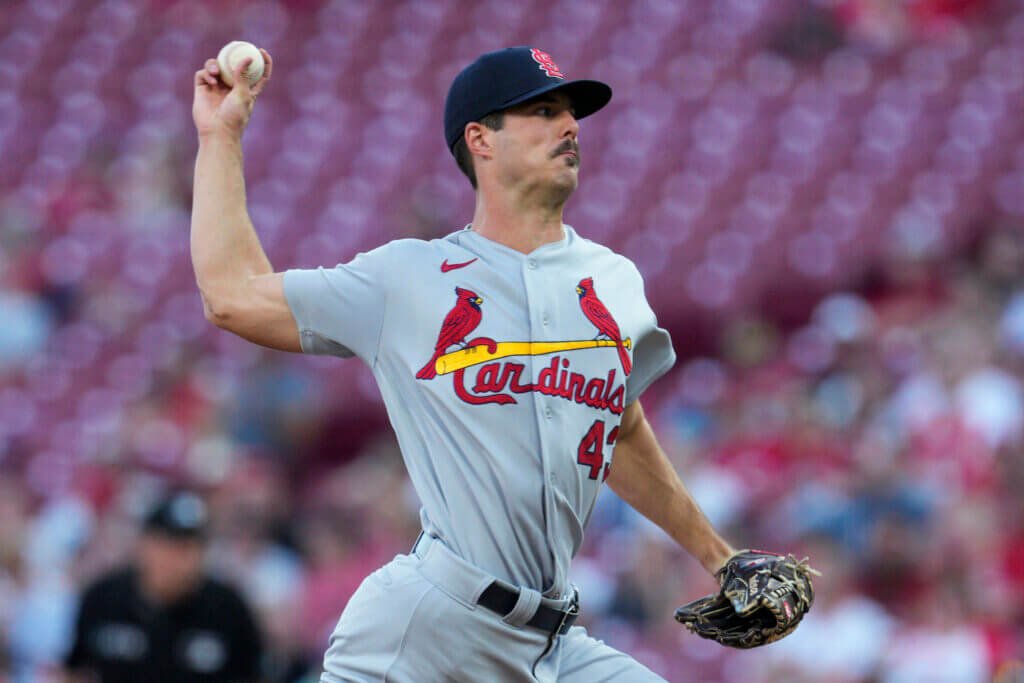
Dakota Hudson’s time in the Cardinals rotation appears to be in jeopardy. Hudson survived two innings before surrendering a third-inning 4 spot to the 51-win Cincinnati Reds. After a bounce-back fourth, Hudson loaded the bases in the fifth before inducing a run-scoring double play that eventually saw him lifted for Jake Woodford with two outs in the fifth. Hudson has been cold since mid-June, posting a 5.88 ERA over his last 13 starts. The Cardinals went 5-8 in those games.
This has become a common trend with Hudson’s starts through the years. The highly touted 2016 first-rounder out of Mississippi State has yet to develop into the front of the rotation starter that comes with the investment. Patience is wearing thin in management, Oli Marmol has been critical of Hudson’s execution and pace-of-play this season; Cards fans have been the most impatient with Hudson’s results as well, so let’s take a QuikTrip through Hudson’s season.
Innings (or lack thereof)
In 2017 and 2018, Dakota Hudson averaged 6 innings per start. He was a more accomplished innings-eater in the minors than Jack Flaherty, Austin Gomber, John Gant, Zac Gallen, Luke Weaver, and Sandy Alcantara. After his first short stint in with the Cardinals in 2018–where he exclusively pitched out of the bullpen–Hudson was set as the #3 starter in 2019. He posted a respectable campaign, compiling a 16-7 record along with a 3.35 ERA; perhaps more importantly he made 32 starts.
226 starting pitchers completed at least 6 innings of work in 2019, Hudson tied for 36th with guys like Walker Buehler, Yu Darvish, Brad Keller, Joe Musgrove, and teammate Miles Mikolas with 18 outings. At the top of that list, if you’re wondering, was Gerrit Cole and Justin Verlander who each hurled 6+ innings in 29 starts. Of the 368 pitchers to make at least one start in 2019, Hudson ranked 41st in innings pitched.
Then again, maybe I’m being a bit too generous. Hudson took on a normal workload for a healthy starting pitcher. 59 pitchers made at least 30 starts that season, and Hudson ranked 38th among those guys in innings pitched. Not great, but still respectable, especially for a rookie pitcher’s first full season. However he did rank higher on the list for pitchers that didn’t complete 5 innings–tied for 27th–but it’s reasonable to say that the more starts a pitcher makes the more this could happen.
Hudson’s 2020 season was a wash as was the entire leagues’. Covid limited Dakota to 8 starts for the year; his final one on September 17th saw him leave with a forearm strain. 10 days later he would undergo Tommy John surgery effectively shutting him down until the end of 2021. It’s a shame too. Hudson showed promise in that Covid-shortened season. He only went 6 or more innings 3 times that season, but not many starters completed 6 that often. The league leaders were Lance Lynn, Yu Darvis, and Aaron Civale at 11. His 39 innings were 108 out of 118 among starters with at least 8 games started. Then again, Jack Flaherty was also on that list at the 105th slot. Sometimes you gotta protect your arms.
As for this season, Hudson has fallen behind the innings pitched mark among starters with at least 20 starts. He ranks 64th out of 95 starters so far, and 61st out of 64 for those with 23 starts. Hudson has lacked consistency in many metrics this season, which has led to him completing 6 or more innings in only 9 of his 23 starts. He ranks tied for 65th among 204 starters to complete at least 6 innings. Even more concerning, his 10 starts of 5 innings or less puts him at 4th place among his peers.
Lack of Command
Scouting reports on Hudson have always been very favorable. MLB.com listed his future value at 55 and Fangraphs at 45. His command was always in question, but seen as a surmountable obstacle, however since 2019 Hudson has struggled to limit walks in his starts.
His 4.4 BB/9 and 86 walks were tops in the majors in 2019. Three seasons later his 4.1 BB/9 places him at 9th, while his 55 walks leads the NL circuit and places him 4th behind Michael Kopech, Framber Valdez, and Dylan Cease. And since 2019, Hudson leads all Major Leaguers with at least 60 starts in BB/9. The league average, in case you’re wondering, for a starting pitcher is 2.9 BB/9.
This season, two-fifths of Hudson’s starts have seen him walk at least 3 or more batters; his 9 games ranking him 13th in the majors this season. For his career, 26 of Hudson’s 64 starts have featured at least 3 free passes to first base–that’s 40.6%.
However, if Dakota Hudson wasn’t weird enough, this career trend of walks hasn’t always resulted in abject disaster. In 2019 Hudson posted a 3.03 ERA in the 15 games he surrendered 3 or more walks. He posted 9 GDPs, however none of those came in his best outings–6 ⅔ of no-hit ball against Milwaukee, 6 ⅓ and 1 earned against Cincy, and 5 scoreless against Chicago. During this season he’s posted a 4.43 ERA in those games, and if you’re wanting more weird info his ERA in games he hasn’t walked 3 hitter is also 4.43.
Metrics
Hudson’s weird career up to this point may be starting to catch up to him. Whereas he’s shown he’s, at the very least, a competent middle of the rotation guy, stats like ERA don’t fully explain how talented or lucky he’s been. A good stat for what he can control is FIP, or Fielding Independent Pitching. FIP takes into account what a pitcher can control and negates defense–this is also going to be important. The formula requires knowing league averages, but the gist is that walks and home runs are bad and strikeouts are good.
Hudson’s 2019 FIP was 4.93 or 1.58 runs higher than his ERA. The league average HR/9 for starters was around 1.4, Hudson came in at 1.1. His walks and lack of strikeouts hurt him a lot though, he only struck out about 7 batters per 9 innings. This gave him a SO/W ratio of 1.58–the league average was 2.89. His 2020 FIP was 4.50 against the league average of 4.45, and 2022 his 4.46 sits higher than the 3.99 average.
What has plagued Hudson worse than walks in his career–especially this season–is his lack of strikeouts. Starting pitchers average between 8 and 8.5 K/9, with 2022 sitting at 8.1. Hudson, for his career, is at 6.3 K/9, but what is more concerning is this season he’s at 5.1. Pitchers like Dylan Cease or Robbie Ray post higher than average walk rates, but they’re able to negate those free passes because they post strikeout rates way higher than league average. Hudson cannot do that.
Scouts have touted his sinker-slider combo as both plus-plus pitches since being drafted, but Hudson hasn’t been able to fully develop those pitches into a lethal combo. Hudson doesn’t throw particularly hard, his career sinker velocity sits around 93 mph–adequate, mind you, but not overpowering–with his slider clocking in around 82. Opponents are hitting .316 against Hudson’s sinker this season, and he’s walked double the amount of batters he’s punched out on it. He’s only been able to throw his sinker in the strike zone about 53.6% of the time.
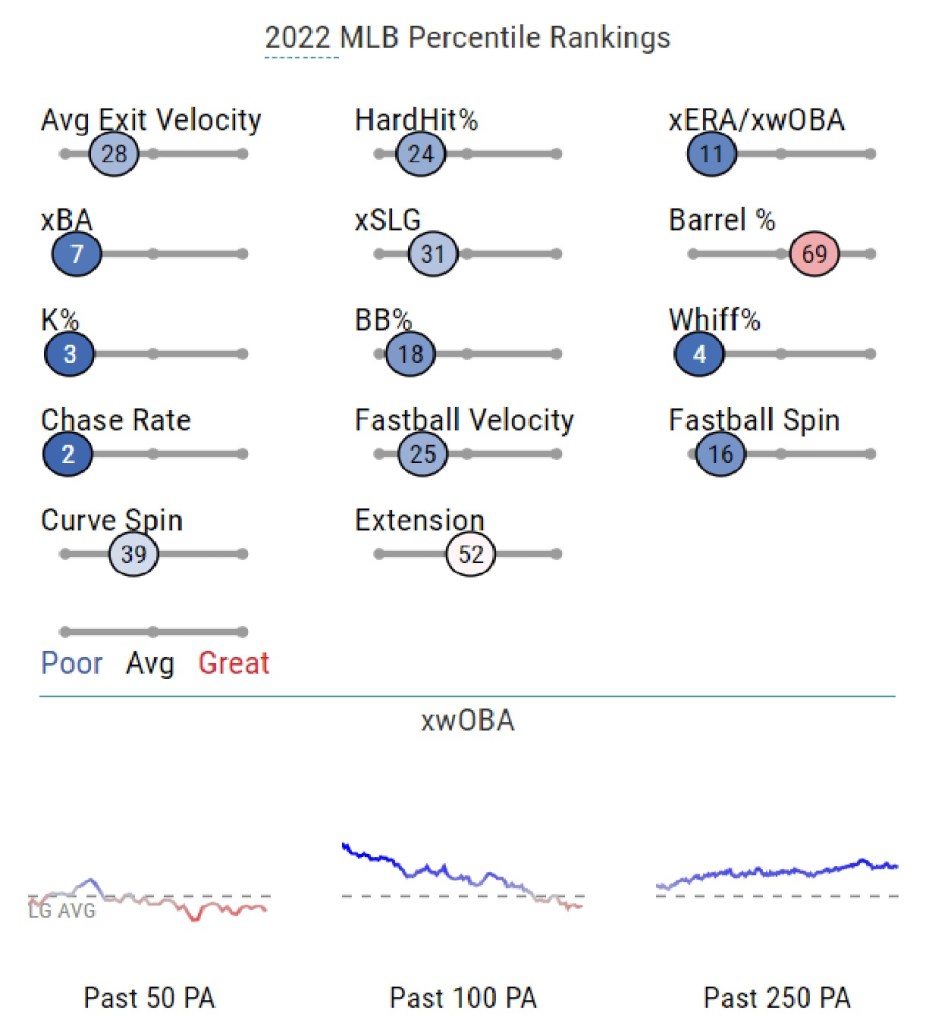
His slider is his out-pitch, but Hudson throws it only 13.7% of the time. Opponents are hitting only .196 against it, and slugging .283. Despite a career-worst strikeout rate, his slider is posting a 32.0% K rate, however Hudson is not putting himself in positions to use that pitch. Even more, he rarely throws it for strikes at 38.3%. Hudson’s chase rate on pitches out of the zone, is in the bottom 2 percentile of all major leaguers–and his K% bottom 3.
To compound these concerns even further, Hudson ranks below league average in what kind of contact he generates: average exit velocity (28th percentile), expected batting average (7th percentile), expected slugging (31st percentile), HardHit% (24th percentile). His pitches also rank worse than league average on spin rates, an important facet of generating movement and swings and misses.
Perhaps this should serve as testament to what kind of defense Hudson has behind him. The 2022 Cardinals entered the season with a record 5 Gold-Glovers from the season before. They currently rank 2nd in the league in Outs Above Average at 25, trailing only the Arizona Diamondbacks. In terms of Defensive Runs Saved, the Cardinals are 5th in the league at 51. In Ultimate Zone Rating the ‘Birds are 2nd at 29.8. Going back to 2019 the Cardinals are 2nd in OAA, 1st in DRS, and 1st in UZR.
Now this is all a bunch of nerd shit, and defensive stats are still wildly unpredictable, but even using the eye test you can see that Hudson is backed by an elite defense with stalwarts like Tommy Edman, Nolan Arenado, and Paul Goldschmidt–important for the kind of pitcher who limits home runs and tries to keep the ball on the ground.
In his defense, Hudson is fresh off of Tommy John. Some pitchers come back just as strong as ever–Justin Verlander–while some pitchers lose a notch or two–Mike Clevinger. Hudson is definitely in the second group, as his sinker velocity is down 1.3 mph compared to 2020, his slider 1.9, and four-seamer 1.3.
Anywhoooooo
The concerns surrounding Dakota Hudson may also decide his future. Hudson was drafted and envisioned as a top 3 starter for the rotation, however his career numbers have shown him to be a back-end guy. To make matters worse for him Jack Flaherty is set to return on Labor Day, and players like Jake Woodford and Andre Palante have performed well with extended outings and starts. Hudson may find himself on the outside looking in or, at best, part of a 6-man rotation.
The right-hander is still young at 27, with time to develop his best pitch further. He’s also coming off of a surgery that kept him out of baseball for a season. However, Hudson’s career has shown concerning trends that have only metastasized into other factors of his game. His ability to pitch consistent innings is gone, negated by his high walk rate. His inability to strike out hitters at, or at least near, the league average clip has led to more of those walks and hits allowed. While Hudson is a fine pitcher at limiting home runs, he is backed by an elite defense that he’s benefitted from since his first year in the majors, meaning he may be worse anywhere else, or God forbid this defense suffers any injuries.
Hudson’s time as a starter may be drawing to a close. The amount of things he would need to improve on may be too much for him to handle, and he’s running out of time to fix them.
 Home of The Worst Fans in Baseball Podcast
Leave a comment